
No Shortcut North
The Iron Dog Snowmachine Race has always been a proving ground, but for racers coming from south of Alaska, the challenge begins long before the starting line. Different climates, unfamiliar terrain, limited access to Arctic conditions, and the logistics of transporting machines and gear thousands of miles north all add layers of complexity to the World’s Longest, Toughest Snowmobile Race.
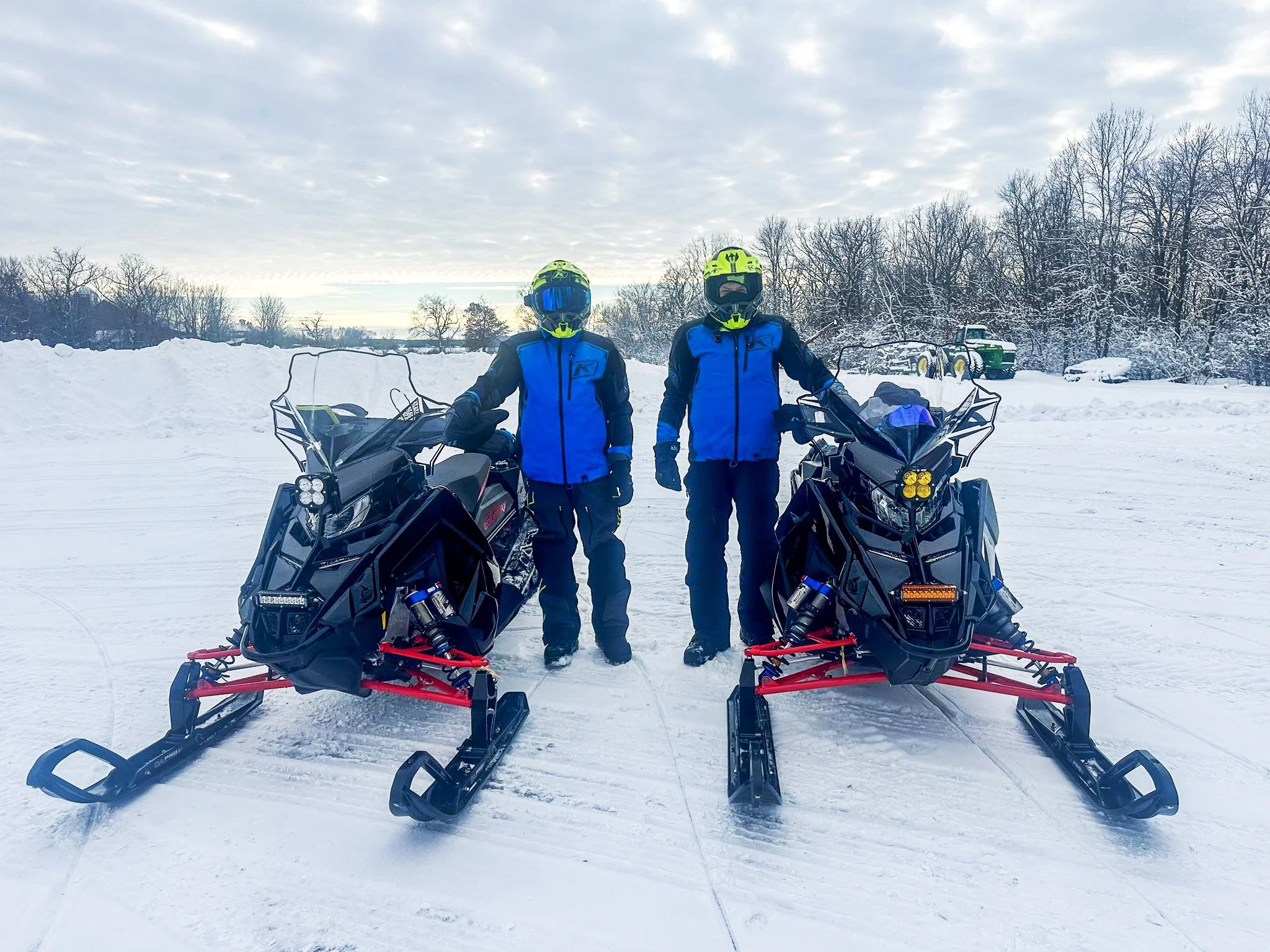
Team 45 (Polaris): veteran Eric Christensen of Centuria, WI, and rookie Luke Christensen of Milltown, WI.
In 2026, the Iron Dog roster includes 15 racers from the Lower 48, representing Utah, Nevada, Minnesota, Wisconsin, Montana, California, and beyond. Some return as seasoned veterans, others arrive as true rookies, but all share a common goal: adapt, endure, and finish.
For Daniel Thomas of Salt Lake City, Utah, adaptation has become a central theme. Entering his fifth Iron Dog, Thomas says nothing truly prepares a racer for the variety the trail delivers.
“I think what I most underestimated about Iron Dog is the variation of trail and weather conditions you experience over the week of racing,” Thomas said. “We did a lot of training from Big Lake to Puntilla, and that was helpful, but nothing compares to the variation of conditions a racer will experience.”
With experience has come perspective.
“They may call it a race, but that doesn’t mean as fast as you can at all times,” Thomas said. “It is a very long race that takes extreme pacing and control to get to the finish.”
Despite the pain and setbacks the race can deliver, Thomas keeps coming back for a simple reason.
“I love Iron Dog,” he said. “I love the trail, the villages, the competitive bond with the racers. I love the vastness, the remoteness, the pain, the heartbreak, the pride at the finish. It contains so much of what I love in life.”
Minnesota’s Dustin Dohrn understands that commitment well. After a DNF in 2021, a 13th-place finish in 2022, and an eighth-place finish in 2024, Dohrn enters his fourth Iron Dog with higher expectations and a deeper appreciation for what it takes just to be ready.
“I think people underestimate how much it takes to prepare for this race,” Dohrn said. “The sled builds alone can turn into a second job, and preparing your body and mind for a race that lasts a week long is a huge commitment.”
Dohrn says his goals have evolved alongside his experience.
“The first year, I was more focused on finishing,” he said. “Now, it’s more realistic to aim higher, but that comes with a lot more preparation.”
Coming from Minnesota, Dohrn says Iron Dog stands apart from any race in the Lower 48.
“It’s exactly what a cross-country snowmobile race should be,” he said. “Point A to point B, you just figure out how to get to the next checkpoint. It’s unlike anything we have back home, and it makes me proud to be part of it.”
Veteran Wisconsin racer Trent Johnson also returns with unfinished business. After mechanical issues ended his 2024 race early, Johnson once again takes aim at earning veteran status, knowing firsthand the challenges Lower 48 racers face before ever hitting the trail; from shipping machines to coordinating time away from work and family.
Alongside the veterans, several true rookies from the Lower 48 will experience Alaska for the first time this winter.
Luke Christensen of Milltown, Wisconsin, grew up watching his uncle, Iron Dog veteran Eric Christensen, race the event. In 2026, the two will line up together as teammates.
“Watching my uncle run Iron Dog the past several years and hearing the stories is what really set my Iron Dog mission in motion,” Christensen said.
Christensen, who grew up dairy farming and now works as a heavy equipment mechanic, says the race’s biggest challenge starts well before the green flag.
“Getting sleds and supplies up there, having the right tools, parts, and clothes, that’s the biggest challenge,” he said.
Still, the goal remains simple.
“Just finishing this race would mean I’ve got what it takes,” Christensen said. “Hopefully earning that veteran status and seeing Alaska for the first time, that’s what I’m looking forward to.”
For Team 27’s Mark Stratton of Sunnyvale, California, the decision to race Iron Dog was rooted in respect for the place, the challenge, and the partnership required to take it on. Racing alongside his lifelong friend Craig Conner, Stratton says Iron Dog appealed precisely because it strips away ego.
“The Iron Dog is the kind of challenge that doesn’t care where you’re from, it only cares how prepared you are,” Stratton said. “Coming from California, that was part of the draw. Alaska demands respect, and tackling it with someone who’s been by your side your entire life brings a level of confidence and humility you don’t take lightly.”
Stratton says the biggest challenge won’t be a single section of trail, but the accumulation of unknowns.
“Conditions, weather, fatigue, and making smart decisions when the trail doesn’t go as planned,” he said. “Alaska has a way of reminding you that you’re a guest in a very big place.”
Preparation for Stratton has focused on durability and discipline, physically, mentally, and mechanically.
“We’ve spent a lot of time learning our machines inside and out,” he said. “Respecting the race also means respecting the equipment that has to carry you across it.”
For Stratton, finishing Iron Dog isn’t about validation, it’s about earning something.
“Finishing the Iron Dog would mean we honored the race and the place it comes from,” he said. “As first-time riders from the Lower 48, it’s not about proving we belong, it’s about earning it.”
Team 27 joins rookies Barney Anselment, Wyatt J. Halek-Hooper, Adam Stafford, Dan Zimmerman, C.J. Vandeputte, Jason Carson, and others rounding out a Lower 48 contingent defined not by familiarity, but by resolve.
For many, Iron Dog is as much about people as it is about miles. Thomas says that spirit is what keeps drawing racers back north.
“I say this to almost every Alaskan racer,” he said. “I don’t believe they understand just how amazing this race is. I am so grateful Alaska shares this race with us each year.”
Different climates, unfamiliar trails, and countless unknowns await the Lower 48 racers in 2026. But if history has shown anything, it’s that determination, preparation, humility, and respect for the race can bridge any distance, even the 2,500 miles of Alaska wilderness that define Iron Dog.
And for those who finish, that elusive title awaits: Iron Dog veteran.
| Team | Name | Status | Hometown |
|---|---|---|---|
| 8 | Daniel Thomas | Veteran | Salt Lake City, UT |
| 9 | Kris Kaltenbacher | Veteran | Sparks, NV |
| 9 | Cole Sabin | Rookie | Hayward, WI |
| 17 | Dustin Dohrn | Veteran | Elgin, MN |
| 20 | Barney Anselment | Rookie | Polson, MT |
| 21 | Wyatt J Halek-Hooper | Rookie | McGregor, MN |
| 21 | Adam Stafford | Rookie | Aitkin, MN |
| 22 | Trent Johnson | Veteran | Hayward, WI |
| 25 | Dan Zimmerman | Rookie | Nisswa, MN |
| 25 | C.J. Vandeputte | Rookie | Nisswa, MN |
| 27 | Mark Stratton | Rookie | Sunnyvale, CA |
| 27 | Craig Conner | Rookie | Henderson, NV |
| 45 | Eric Christensen | Veteran | Centuria, WI |
| 45 | Luke Christensen | Rookie | Milltown, WI |
| 48 | Jason Carson | Rookie | Coalville, UT |